Startup Valuation in India 2026: The 4 Methods Investors Use — And Why the Number You Agree On Isn't the Number That Counts
You and your investor can agree on ₹12 crore. That doesn't make ₹12 crore legally valid. Here are the four methods Indian investors actually use — with 2026 benchmarks — and the statutory valuation rules most founders discover too late.
You and your investor can shake hands on ₹12 crore. That handshake doesn't make ₹12 crore legally valid. In India, two different professionals, under two different laws, have to independently arrive at a number — and they often don't arrive at yours.
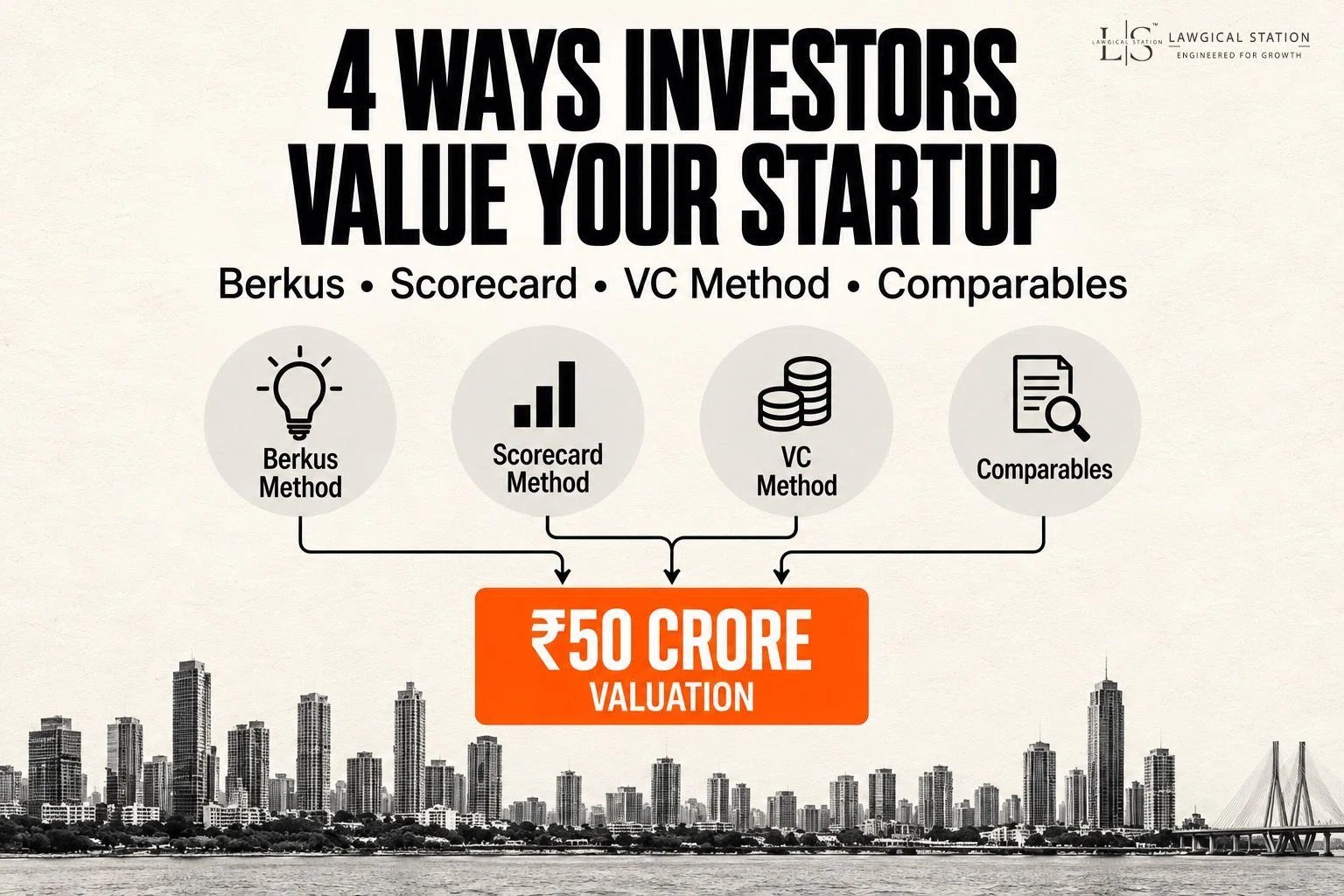
The short version: At seed stage, investors value you using one of four methods — Berkus, Scorecard, VC Method, or Comparable Company Analysis. These are negotiation tools. But India separately requires a statutory valuation — under Rule 11UA for income tax, Section 247 of the Companies Act for share allotments, and FEMA rules for foreign investment. Founders who understand the difference negotiate better and file cleaner.
Let me break down all four methods with real 2026 India numbers, then show you the part nobody explains.
First — the two numbers you cannot mix up
Before any method makes sense, get this right. It's the most expensive early mistake in Indian fundraising.
| What it means | |
|---|---|
| Pre-money valuation | What your company is worth before the new money comes in |
| Post-money valuation | Pre-money plus the investment amount |
| Investor's ownership | Investment ÷ Post-money |
Example: ₹5 crore pre-money + ₹1 crore investment = ₹6 crore post-money. The investor owns 16.67% (1 ÷ 6), not 20%.
Founders who divide by pre-money hand over more equity than they intended. I've seen this cost a founder several percentage points of their company in a single email.
We cover the full mechanics — including how the ESOP pool quietly changes the math — in our dedicated post on pre-money vs post-money valuation. For now, hold onto the formula, because every method below feeds into it.
Method 1 — The Berkus Method
Best for: Pre-revenue, idea-and-prototype stage Created by: Angel investor Dave Berkuc
The Berkus Method doesn't try to predict revenue. It asks a simpler question: how much risk has this founder already removed?
You score five factors, each with a capped value:
| Factor | Maximum value (India 2026) |
|---|---|
| Sound idea | ₹50 lakh |
| Working prototype | ₹1 crore |
| Quality management team | ₹1.5 crore |
| Strategic relationships / LOIs | ₹75 lakh |
| Product rollout / early customers | ₹1 crore |
| Maximum valuation | ~₹4.75 crore |
Why it works: it's honest about what a pre-revenue company is — a collection of risks, some of which you've already retired. A founder with a prototype and two signed LOIs genuinely is worth more than one with a slide deck.
Where it breaks: the caps are arbitrary and regionally adjusted. Indian investors often use their own maxima. It's a sanity check, not a science. And note the ceiling — Berkus almost never justifies a valuation above roughly ₹5 crore, which is exactly the range where pre-seed rounds actually happen.
Method 2 — The Scorecard Method
Best for: Pre-revenue or early-revenue seed rounds Created by: Bill Payne
The Scorecard Method starts from a real market benchmark and adjusts it. That's what makes it more defensible than Berkus — it's anchored to what comparable companies are actually being valued at, not to a fixed table.
The standard weights:
| Factor | Weight |
|---|---|
| Management team | 30% |
| Size of the opportunity | 25% |
| Product / technology | 15% |
| Competitive environment | 10% |
| Marketing / sales channels | 10% |
| Need for additional investment | 5% |
| Other factors | 5% |
You compare yourself to the regional average on each factor, assign a rate, and multiply.
Worked example
Assume the average Indian seed-stage valuation is ₹10 crore and you assess yourself like this:
| Factor | Weight | Your rate vs average | Contribution |
|---|---|---|---|
| Management team | 30% | 120% (strong) | 0.360 |
| Size of opportunity | 25% | 100% (average) | 0.250 |
| Product / technology | 15% | 110% | 0.165 |
| Competitive environment | 10% | 90% | 0.090 |
| Marketing / sales | 10% | 80% (weak) | 0.080 |
| Additional investment needed | 5% | 100% | 0.050 |
| Other | 5% | 100% | 0.050 |
| Total factor | 1.045 |
Valuation = ₹10 crore × 1.045 = ₹10.45 crore
Look at what that table tells you. Your weak go-to-market is dragging your valuation down by roughly ₹2 crore. Fixable problems show up as numbers here — which is exactly why this method is useful. It turns an argument about "what I'm worth" into a conversation about "what we should fix."
India 2026 seed benchmarks: commonly cited at ₹8–12 crore, with some sources using ₹3–8 crore for narrower comparables. Use the benchmark that matches your sector, not the highest one you can find.
Method 3 — The VC Method
Best for: Seed to Series A, where an exit is at least imaginable Used by: Almost every institutional investor, whether they say so or not
This is the method that actually drives term sheets. It works backwards from the exit.
The formula: Post-money valuation = Projected exit value ÷ Investor's target return multiple
Worked example
- Projected exit value in year 6: ₹300 crore
- Your investor's target return: 20x
Post-money = ₹300 crore ÷ 20 = ₹15 crore
- If they invest ₹3 crore:
- Pre-money = ₹15 crore − ₹3 crore = ₹12 crore
- Investor owns 3 ÷ 15 = 20%
Now the part that changes everything — dilution
That 20% assumes nothing changes. But between now and exit, you'll raise more rounds, and every one of them dilutes this investor.
If you expect 30% dilution across future rounds, the investor needs to hold more today to end up with 20% at exit:
20% ÷ (1 − 0.30) = 28.6%
On a ₹15 crore post-money, that's a ₹4.29 crore cheque — not ₹3 crore.
This is the single most important thing to understand about the VC Method: the investor's target return and their dilution assumption are doing more work than your pitch. Two investors can agree your company is worth ₹300 crore at exit and still offer wildly different terms, because they're using different return targets.
Typical Indian target returns run 10x–30x, implying IRRs of roughly 30–60%. Early-stage investors take bigger bets, so they need bigger multiples. That's not greed — it's the arithmetic of a portfolio where most companies return nothing.
Method 4 — Comparable Company Analysis
Best for: Growth and later stages (Series B+), and non-resident investment pricing Also called: Market multiples, CCA
Here you take a real revenue metric and apply a multiple from similar companies.
India 2026 multiples
| Sector | Typical | Premium |
|---|---|---|
| B2B SaaS | 5–8x ARR | 10–15x ARR |
| AI startup | 8–15x ARR | 20–30x ARR |
| Consumer app (high retention) | 3–6x ARR | 8–12x ARR |
| D2C brand | 2–4x Revenue | 5–8x Revenue |
| Marketplace | 1–3x GMV | 4–6x GMV |
| Fintech (lending) | 2–4x NII | 5–8x NII |
Worked example, with the adjustment everyone forgets
Your B2B SaaS company has ₹5 crore ARR. You benchmark against listed SaaS companies at 6x:
₹5 crore × 6 = ₹30 crore
But those comparables are listed. Their shares trade every day; yours don't. Investors apply a Discount for Lack of Marketability (DLOM) of 15–35% to bridge that gap.
At a 20% DLOM: ₹30 crore × 0.80 = ₹24 crore
A ₹6 crore difference, purely because your shares can't be sold on a screen tomorrow. Founders routinely benchmark against listed companies and forget this adjustment — then feel lowballed by an offer that's actually following standard practice.
Which method applies when
| Your stage | Methods in play |
|---|---|
| Idea, no product | Berkus + Risk Factor Summation |
| Pre-revenue, some traction | Scorecard + Berkus as cross-check |
| Early revenue (Seed / Series A) | VC Method + Revenue Multiple |
| Growth (Series B+) | Comparable Company Analysis + DCF |
| Foreign investor involved | Statutory methods under FEMA (see below) |
In practice, no good investor uses one method. They triangulate — run two or three, see where the numbers cluster, and negotiate inside that band.
The part nobody explains: negotiation valuation vs statutory valuation
Here's the section I'd ask you to read twice.
Everything above — Berkus, Scorecard, VC Method, multiples — is a negotiation tool. Two parties agreeing on a number.
But India separately requires a statutory valuation for certain actions. And the statutory valuation follows rules that have nothing to do with what you and your investor agreed.
This is the gap that catches founders. You agree on ₹12 crore. Your investor is happy. Then you discover that the report filed with the ROC and RBI has to independently justify that price under a prescribed methodology — and if it doesn't, the filing is rejected or, worse, a legacy assessment opens years later.
Which valuation, for which purpose
| Purpose | Who certifies | Method |
|---|---|---|
| Agreeing price with an investor | Nobody — pure negotiation | Berkus, Scorecard, VC Method, Multiples |
| Income tax (Rule 11UA, legacy assessments) | SEBI-registered Category I Merchant Banker | NAV or DCF |
| Companies Act — preferential allotment, private placement, ESOP, buyback | IBBI Registered Valuer (Securities or Financial Assets class) | Section 247 |
| Foreign investment (FEMA) | SEBI merchant banker, practising CA, or practising CMA | Any internationally accepted method, arm's length |
Three things to notice:
-
The certifiers are different people. A registered valuer registered only for "land and building" cannot sign a securities valuation. Using the wrong professional invalidates the report and gets your filing rejected.
-
A single document rarely satisfies all requirements. A share issue to a foreign investor typically triggers both an IBBI registered valuer report under the Companies Act and a FEMA pricing certificate. Two reports, two professionals, one transaction. Budget for both.
-
Rule 11UA still matters even though angel tax is gone. Angel tax — Section 56(2)(viib) — was abolished prospectively, and the Income-tax Act 2025 didn't re-enact it. But the abolition is not retrospective, so older issuances can still face open assessments, reassessments and appeals. For those legacy years, a contemporaneous Rule 11UA valuation from a merchant banker is your primary defence. We cover the abolition in detail in our separate post on angel tax.
Rule 11UA in brief
- Resident investors: NAV or DCF method. DCF must be certified by a SEBI-registered Category I Merchant Banker
- Non-resident investors: five additional methods were added in 2023 — Comparable Company Multiple, Probability Weighted Expected Return, Option Pricing, Milestone Analysis, and Replacement Cost
- Safe harbour: under Rule 11UA(4), if your issue price doesn't exceed 110% of the Rule 11UA fair market value, the issue price itself is accepted
FEMA in brief
Under Rule 21 read with Schedule I of the Foreign Exchange Management (Non-Debt Instruments) Rules, 2019, shares issued to a non-resident must be priced not less than fair market value, on an arm's-length basis, using an internationally accepted method. The report is filed with the RBI via Form FC-GPR for fresh issuance or Form FC-TRS for transfers.
Companies Act in brief
Section 247 requires valuations under the Act to be done by a valuer registered with IBBI, under the Companies (Registered Valuers and Valuation) Rules, 2017. Rule 8(3) prescribes what the report must contain: valuer identity, conflict disclosures, valuation date, information sources, methodology, key factors, and caveats. Get this wrong and the penalty under Section 247(3) is ₹50,000 — rising to imprisonment up to one year and a fine of ₹1–5 lakh where fraud is involved.
What the Indian market actually looks like in 2026
Theory is fine. Here's the market you're actually raising in.
| Metric | 2026 position |
|---|---|
| Funding, H1 2026 | $5.2 billion — down 9% YoY |
| Deal count | 501 deals — up 7% YoY |
| Overall median ticket | Stable at ~$3 million |
| Late-stage median cheque | $10 million — down 68% YoY |
| Average seed cheque | ~$1.3 million — nearly doubled from ~$0.8M |
| Seed deal count | 420 — down 47% from 797 |
| Seed-stage funding | $478 million — up 18% YoY |
| Typical seed valuation | $10–25 million |
| Seed SaaS EV/Revenue multiple | 12–15x median |
| Average Series A | $15 million, valuation $40–120 million |
| AI vs non-AI | AI seed $3–5M / Series A $10M+; non-AI seed $2–4M / Series A $5–8M |
| Series A revenue expectation | ~$1.5 million ARR |
| Seed to Series A | ~616 days (about 20 months) |
What this table is really telling you: seed cheques got bigger while the number of seed deals collapsed by nearly half. Fewer companies are raising seed, and the ones that do are raising more. That's a market that has stopped making bets on potential and started paying for evidence.
The revenue bar has moved too. Investors now expect ₹2–3 crore in annual revenue at seed stage — up from around ₹1 crore a few years ago. In D2C, Series A expectations have roughly doubled to the ₹50–60 crore range.
The practical implication: if you're building your seed valuation on a story, 2026 is a harder market for that than 2021 was. If you're building it on revenue, you're in the right market — the money is there, it's just concentrating.
Mistakes I see founders make
- Confusing pre-money and post-money. The most expensive error in the list, and the easiest to avoid
- Benchmarking against listed companies without applying DLOM. Your ₹30 crore is closer to ₹24 crore
- Using Berkus to justify a ₹12 crore valuation. The method caps out around ₹4.75 crore. Investors know this
- Forgetting future dilution in the VC Method. Your investor is pricing it in even if you aren't
- Assuming a handshake valuation is legally valid. It isn't. The statutory report follows its own rules
- Commissioning one valuation report for a transaction that needs two. Foreign investment = Companies Act report + FEMA certificate
- Using a valuer registered for the wrong asset class. Land-and-building registration cannot sign a securities valuation
- Treating a valuation as a permanent fact. It's a date-stamped opinion. Today's ₹24 crore is next year's starting point, not a floor
- Picking the method that gives the highest number. Investors will run their own. Getting caught inflating is worse than starting low
Frequently asked questions
Which valuation method is best for an Indian startup? It depends on stage. Berkus for idea stage, Scorecard for pre-revenue with market data, VC Method for seed to Series A, and Comparable Company Analysis for growth. Serious investors triangulate across two or three.
Is a valuation report mandatory to issue shares in India? For a preferential allotment or private placement under the Companies Act, yes — an IBBI registered valuer's report under Section 247. Rights issues and bonus shares generally don't need one.
Do I still need a Rule 11UA valuation now that angel tax is abolished? Not for new issuances for income-tax purposes. But it remains advisable, and it's essential for defending legacy assessment years. It's also still relevant for ESOP fair value and general valuation governance.
Can the same report be used for Companies Act and FEMA? Rarely. The Companies Act needs an IBBI-registered valuer; FEMA accepts a SEBI merchant banker, practising CA, or CMA. A foreign share issue typically needs both.
Does India have something like the US 409A valuation? Not an exact equivalent. The closest analogues are Rule 11UA for income tax, Section 247 for company law, and FEMA pricing for foreign investment. Each has its own certifier and methodology.
What discount is applied to unlisted startup valuations? A Discount for Lack of Marketability of 15–35%, to reflect that unlisted shares can't be sold quickly.
What's the difference between a fundraising valuation and a business valuation? A fundraising valuation is a negotiation benchmark. A business valuation is a statutory, methodology-driven opinion prepared by a registered professional. They serve different purposes and often arrive at different numbers — that's normal, and it's why you should never assume one substitutes for the other.
My honest take
Valuation is where founders feel the most powerful and understand the least.
There's a stage in every fundraising conversation where a number gets said out loud, and both sides quietly decide whether to react. Founders walk in having read about Berkus and multiples, expecting a formula. What they find is a negotiation, informed by models.
Here's what I'd want you to take away:
Learn the methods so you can hold your ground, not so you can find the highest number. An investor who asks you how you arrived at your valuation is testing your thinking, not your arithmetic. "Berkus gave me ₹4.75 crore and the VC Method gave me ₹14 crore, so we're landing at ₹12 crore" is a strong answer. "That's what the last round was" is a weak one.
And understand that your negotiated number and your statutory number are different things serving different masters. Your investor wants a deal that works. The income tax department wants a price that can be defended. The ROC wants a filing that complies. The RBI wants a price that clears fair value. Four audiences, and the report that satisfies one won't always satisfy the others.
Founders who plan for that — who budget the time and the professional fees for the reports they'll actually need — raise smoothly.
Founders who don't spend the two weeks after the term sheet discovering that the number they celebrated isn't the number they can file.
Get the valuation right for the negotiation. Get the report right for the law. They're two different jobs, and both matter.
This article is for general information and reflects the position as of September 2026. Valuation rules and market benchmarks change. Please verify current provisions or consult a professional before relying on any figure here.
The Lawgical Station team brings together CAs, CSs and tax specialists with decades of combined experience advising founders, SMEs and professionals on tax, compliance and business structuring across India.