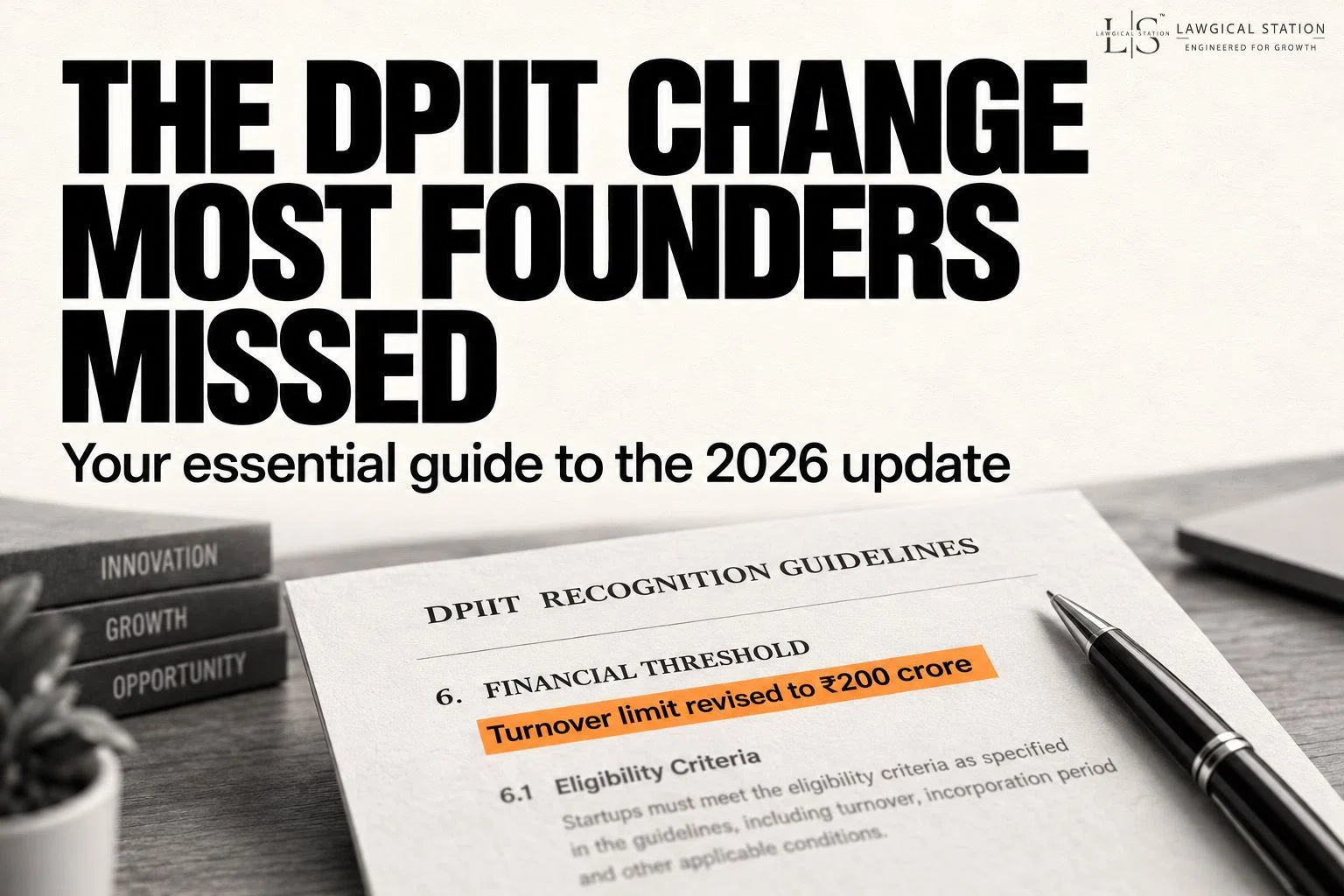
Section 80-IAC Startup Tax Holiday 2026: 3 Years of Zero Tax — And the One Election That Can Take It All Away
Section 80-IAC (now Section 140) gives startups 3 years of 100% tax deduction. But one irrevocable form, filed in a loss year, can cancel it forever. Here's how to claim it — and how not to lose it.

Every founder knows about the tax holiday. Very few know that a single irrevocable form, filed in a loss year, can cancel it before you ever become profitable. Here's the full picture — including the part most guides leave out.
The short version: Section 80-IAC — now Section 140 under the Income Tax Act, 2025 — lets an eligible startup claim a 100% deduction on business profits for any 3 consecutive years out of its first 10. But three conditions trip up most founders: you must be a Private Limited Company or LLP (not an OPC), you need a separate IMB certificate on top of DPIIT recognition, and for companies, MAT still applies — so "zero tax" isn't literally zero.
And there's a fourth condition nobody talks about: choosing the wrong tax regime can permanently cancel this benefit.
Let me walk you through it properly.
What Section 80-IAC actually is
Under the Income-tax Act, 1961, this provision was Section 80-IAC. From 1 April 2026, the new Income-tax Act, 2025 took effect, and the same benefit now sits under Section 140.
The provision itself is unchanged: a 100% deduction on the profits and gains of your eligible business, for any 3 consecutive years you choose within the first 10 years from incorporation.
You'll still hear it called 80-IAC everywhere — including by the department. Use both names when you search, and don't be confused when you see the other one.
Two 2026 changes worth knowing:
- The incorporation deadline was extended to 31 March 2030 by the Union Budget 2025. If you were worried the window had closed, it hasn't — it moved further out.
- DPIIT released a Tax Playbook in June 2026, consolidating how these benefits are meant to be claimed. It's worth reading alongside this.
Who actually qualifies
This is where I see the most confusion, because the eligibility for the tax holiday is narrower than DPIIT recognition itself.
| Requirement | Detail |
|---|---|
| Entity type | Private Limited Company or LLP only |
| Incorporation date | On or after 1 April 2016, and up to 31 March 2030 |
| Age | Less than 10 years from incorporation |
| Turnover | ₹100 crore (see the note below — this figure is changing) |
| Nature of business | Innovation, development or improvement of products/processes/services, or a scalable business model with employment or wealth creation potential |
| DPIIT recognition | Mandatory |
| IMB certificate | Mandatory — and separate |
| Anti-abuse | Not formed by splitting up or reconstructing an existing business; no transfer of previously used plant and machinery (limited exception up to 20%) |
Read that first row again. One Person Companies, partnership firms, sole proprietorships and cooperative societies can get DPIIT recognition but cannot claim the 80-IAC holiday.
I've had this conversation more times than I can count. A founder registers an OPC because it seemed simpler, gets DPIIT recognition, and then discovers the tax holiday isn't available to them. Structure your entity with this in mind from day one.
A note on the turnover limit: Most sources still cite ₹100 crore. However, some 2026 references point to an increase to ₹300 crore under the new Act. This is an active area of change — please confirm the current threshold with a professional or the official portal before you plan around it.
What you actually save
Let me make this concrete, because "100% deduction" hides the real picture.
Take a Private Limited Company earning ₹1 crore of profit each year for three holiday years.
| Without the holiday | With the 80-IAC holiday |
|---|---|
| Total profit over 3 years | ₹3,00,00,000 |
| ₹3,00,00,000 | ₹3,00,00,000 |
| Normal income tax | ~₹78,00,000 |
| ~₹78,00,000 | Nil |
| MAT payable | — |
| — | ~₹46,80,000 |
| Immediate cash saved | — |
| — | ~₹31,00,000 |
| MAT credit carried forward | — |
| — | ~₹46,80,000 |
Two things to take from this table.
First — the saving is real but it isn't zero. Most articles describe 80-IAC as "zero tax." For companies, that's not accurate. See the next section.
Second — the MAT credit isn't lost money. It sits on your books and can be set off against regular tax in later years, for up to 15 assessment years. During the holiday you're effectively prepaying tax at a lower rate.
MAT — the part most guides skip
Here's the honest version, and it's the reason I wrote this blog.
For companies: During your 80-IAC holiday, your normal income tax becomes nil. But Minimum Alternate Tax still applies at 15% (plus surcharge and cess) on book profits. So you still write a cheque.
The good news: that MAT is not wasted. It becomes a credit under Section 115JAA, carried forward for up to 15 assessment years, and set off against regular tax once your holiday ends.
For LLPs: There's no MAT — LLPs are outside Section 115JB. An LLP may instead pay AMT under Section 115JC at 18.5% of adjusted total income. In practice, a qualifying LLP often ends up with a cleaner holiday.
This is exactly the kind of detail that separates a plan from a guess. If someone tells you the holiday means you'll pay nothing at all, ask them about MAT.
The trap: Section 115BAA can cancel your holiday forever
Now the part I really want you to remember.
Section 115BAA offers companies a flat 22% tax rate — roughly 25.17% effective after surcharge and cess. It sounds attractive. But it comes with a condition: you must give up most exemptions and deductions, including 80-IAC.
And the election is irrevocable. Once you file Form 10-IC, you cannot go back.
Here's how the trap springs. A founder, in their early loss-making years, sees 22% and thinks: there's no profit anyway, so there's nothing to lose. They file Form 10-IC. Two years later the company turns profitable — and the tax holiday they were counting on is gone. Permanently.
Run the numbers and the mistake becomes obvious:
| Option | Tax impact |
|---|---|
| 80-IAC holiday (on ~₹2 crore profit across 3 years) | Saves roughly ₹50 lakh |
| 115BAA rate benefit (25% → 22% on the same profit) | Saves roughly ₹6 lakh |
You'd be trading away ₹50 lakh to save ₹6 lakh.
The correct sequence:
- Stay in the normal regime and use your 80-IAC holiday first, in your earliest profitable years.
- Only after the holiday is exhausted and your losses are used, consider moving to 115BAA for the steady years that follow.
- Never file Form 10-IC during loss years or before you've claimed the holiday. The election must be filed before the due date of the return for the year you want it. Model it properly. Don't tick it in a hurry.
Choosing your three years — decide carefully
The three years must be consecutive, and once chosen, they cannot be changed. This makes it a genuine planning decision, not a formality.
The principle is simple: pick the three consecutive years with the highest profits within your first ten.
But the timing is not only about profit. Consider:
- When your early losses will be fully set off
- When MAT credit becomes usable
- Whether a funding round or a large one-time gain is landing in a particular year Also note: the deduction applies to your eligible business profits only. Interest income, rental income and other unrelated income remain taxable. Don't assume the holiday covers everything on your P&L.
Because the IMB review can take months, apply early — not in the week before your filing deadline. You cannot retroactively claim a year that has already been assessed.
Documents you'll need for the IMB application
| Document | Notes |
|---|---|
| Certificate of Incorporation | From MCA |
| Entity PAN | Company or LLP PAN — not personal |
| DPIIT recognition certificate | Must be obtained first |
| MOA & AOA, or LLP Agreement | |
| Board resolution | Authorising the 80-IAC application |
| Audited financial statements | Balance Sheet and P&L since incorporation |
| Income tax returns | Since incorporation |
| Shareholding pattern / cap table | Updated |
| Pitch deck | Keep it to about 5 slides |
| Innovation write-up | What's new, scalable and hard to replicate |
| Video pitch | Typically 2–3 minutes, per portal guidelines |
| Financial projections | With employee and funding details |
| Bank statements, term sheets, investment agreements | Where applicable |
That video pitch surprises people. Prepare it properly — it's part of how the IMB assesses whether your business is genuinely innovative.
The process, step by step
Step 1 — Get your entity registered. Private Limited Company or LLP.
Step 2 — Obtain DPIIT recognition. Free, typically 2–5 working days.
Step 3 — File the separate 80-IAC / IMB application through the Startup India portal's Section 80-IAC section. This is the step most founders miss entirely.
Step 4 — Fill in company details, financial summary, shareholding structure and business/innovation details.
Step 5 — Upload your documents, including the pitch deck and video pitch.
Step 6 — Submit. The application is routed to the Inter-Ministerial Board — drawn from DPIIT, CBDT and the Department of Biotechnology.
Step 7 — Respond promptly to any clarification requests through the portal. Ignoring these is a common reason applications stall.
Step 8 — On approval, you receive the Certificate of Eligible Business under Section 80-IAC.
Timelines to plan around
| Stage | Typical time |
|---|---|
| DPIIT recognition | 2–5 working days (sometimes ~72 hours) |
| IMB review target | DPIIT aims to review complete applications within 120 days |
| Realistic IMB wait | 3–4 months, with a range of 2–6 months depending on IMB meeting schedules |
Plan for the longer end. Build it into your tax planning calendar, not your filing-week panic.
Mistakes I see founders make
- Assuming DPIIT recognition gives the tax holiday. It doesn't. The IMB certificate is a separate approval.
- Registering as an OPC or partnership firm. Neither is eligible for 80-IAC, even with DPIIT recognition.
- Filing Form 10-IC (115BAA) in a loss year. The single most expensive mistake in this list.
- Expecting literally zero tax. MAT applies to companies during the holiday.
- Assuming all income is covered. Only eligible business profits are.
- Choosing the three years casually. They're consecutive and unchangeable.
- Applying late. You can't claim a year that's already been assessed.
Frequently asked questions
Is Section 80-IAC now a different section?
Yes. From 1 April 2026, under the Income-tax Act, 2025, it is Section 140. The benefit itself is unchanged, and it's still commonly called 80-IAC.
Can an OPC or a partnership firm claim this?
No. Only a Private Limited Company or an LLP. Other entity types may still get DPIIT recognition but cannot claim this deduction.
Is DPIIT recognition enough for the tax holiday?
No. You need a separate IMB certificate from the Inter-Ministerial Board.
Will I pay absolutely no tax during the holiday?
Not if you're a company. MAT at 15% (plus surcharge and cess) applies on book profits. It becomes a carry-forward credit usable for up to 15 assessment years. LLPs face AMT under Section 115JC instead.
Can I choose any three years?
Any three consecutive years within your first 10 from incorporation. Once chosen, they cannot be changed — so plan them around your highest-profit years.
What happens if I opt for Section 115BAA?
You permanently give up the 80-IAC holiday. The election is irrevocable. Use the holiday first, and consider 115BAA only afterwards.
How long does IMB approval take?
DPIIT aims to review complete applications within 120 days, but in practice expect 3–4 months, and possibly up to 6.
My honest take
The 80-IAC holiday is one of the most valuable provisions available to an Indian startup. On a ₹1 crore annual profit, it's the difference between writing a ₹26 lakh cheque and writing a ₹15.6 lakh one — with the difference coming back to you later as credit.
But it is not a form you fill. It's a decision you make, and it has to be made in the right order:
Get the entity right. Get DPIIT recognition. Get the IMB certificate. Stay in the normal regime. Choose your three years deliberately. Only then think about 115BAA.
Founders who get this sequence right save lakhs. Founders who get it wrong often don't find out until it's too late to fix — because by then, the form is filed and the holiday is gone.
If you're approaching profitability, this is worth an hour with your CA before you file anything. That hour is cheaper than the mistake.
This article is for general information and reflects the position as of September 2026. Tax provisions change, and the turnover threshold for this section is currently in flux. Please verify current provisions or consult a professional before acting on it.
The Lawgical Station team brings together CAs, CSs and tax specialists with decades of combined experience advising founders, SMEs and professionals on tax, compliance and business structuring across India.