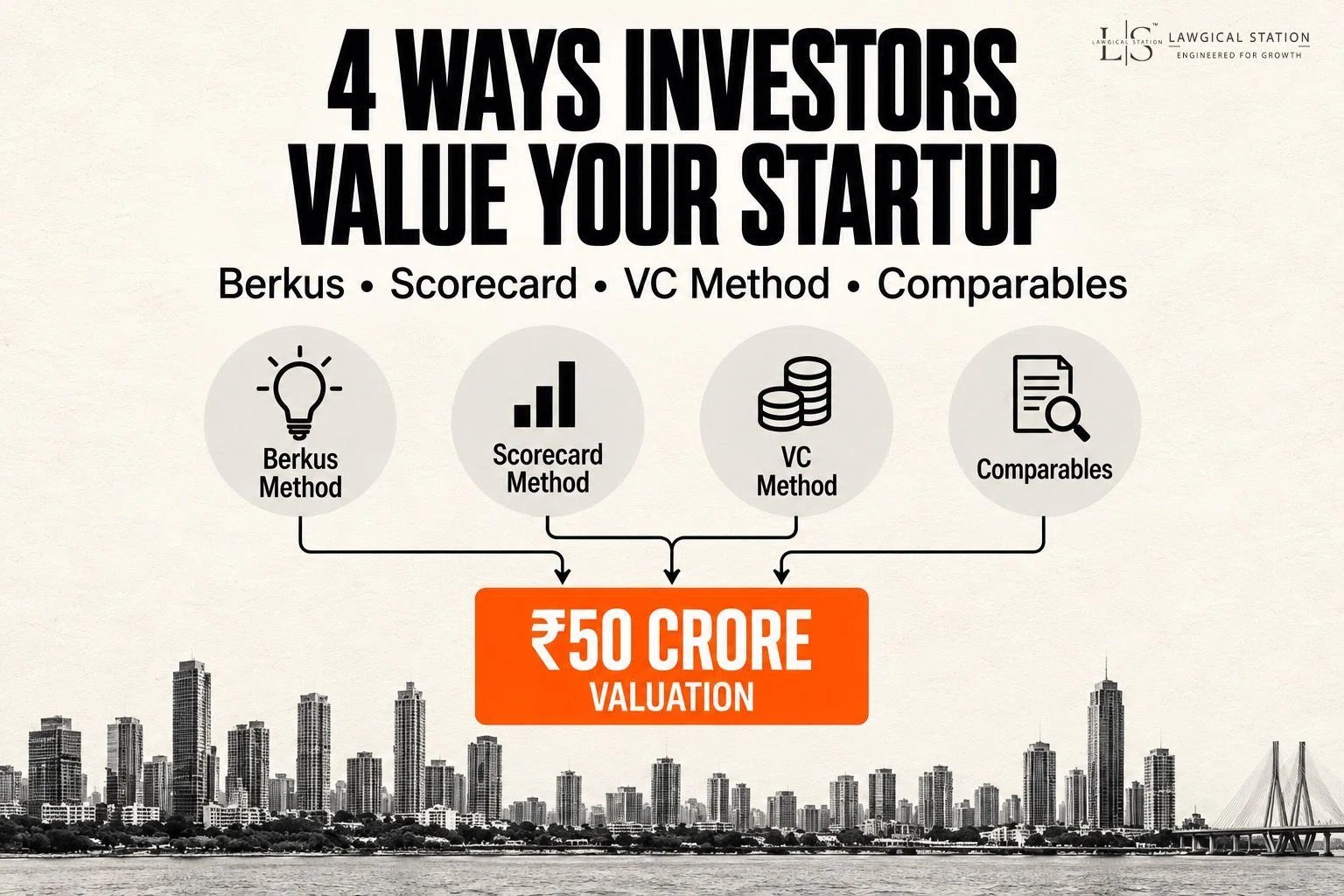
Pre-Money vs Post-Money Valuation 2026: The Two Words in Your Term Sheet That Quietly Cost Founders a Tenth of Their Company
Two founders raise the same amount, at the same valuation, from the same investor. Five years later one owns 10% more of their company. The difference was a single phrase in the term sheet — and it's usually buried on page four.
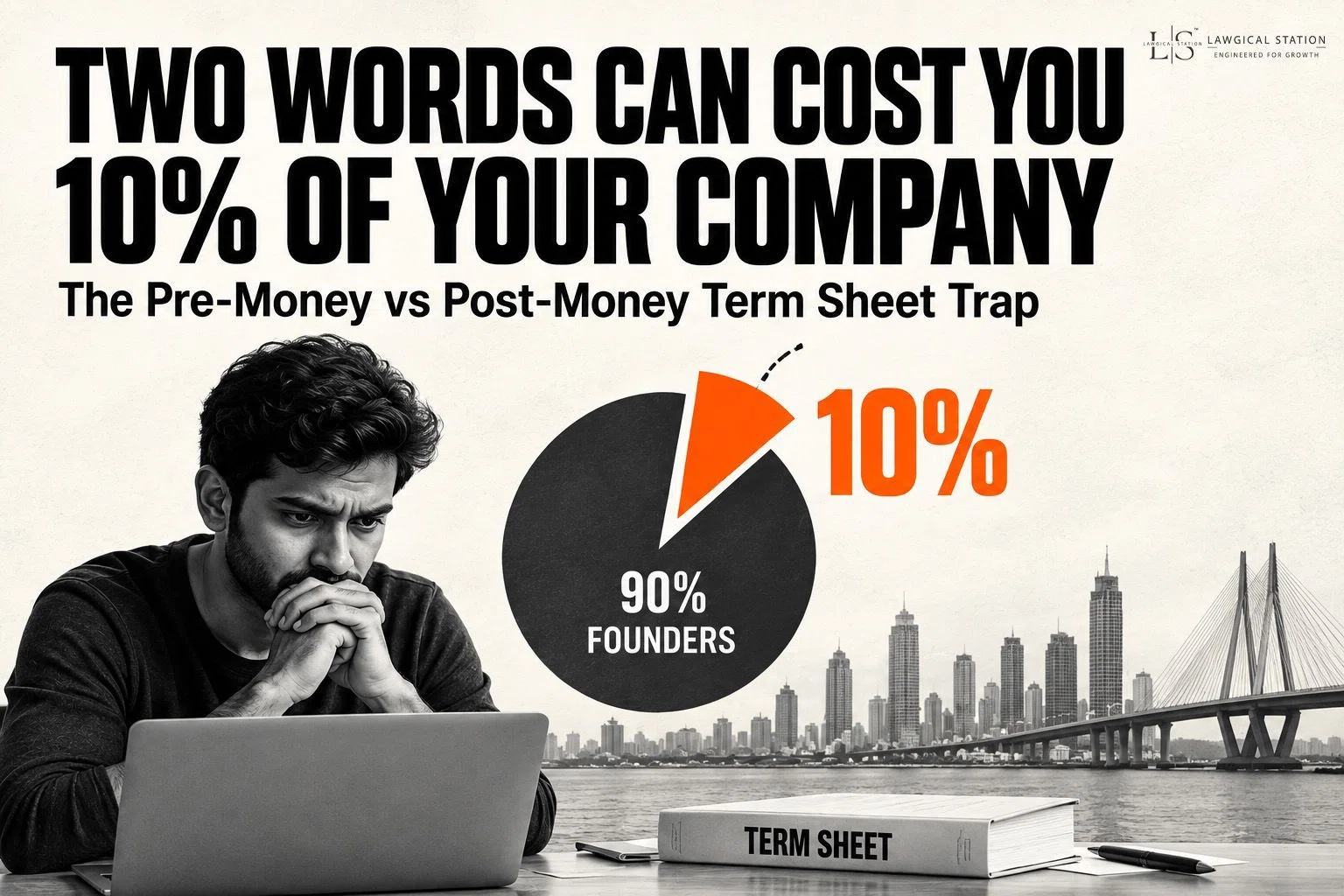
Two founders raise the same amount, at the same valuation, from the same investor. Five years later, one owns 10% more of their company than the other. The difference was a single phrase in a term sheet neither of them read closely.
The short version: Pre-money is what your company is worth before the investment. Post-money is pre-money plus the cheque. That part everyone knows. What most founders miss is the ESOP pool shuffle — whether your employee option pool is created before or after the investor's money lands decides who absorbs that dilution. Get it wrong and you, alone, pay for employee equity. Get it wrong across two rounds and it can cost you more than the investor's entire stake.
Let me show you the arithmetic, because once you see it, you can't unsee it.
The basic math, done properly
| Term | Meaning |
|---|---|
| Pre-money valuation | Company value before new money |
| Post-money valuation | Pre-money + investment |
| Investor's ownership | Investment ÷ Post-money |
Example: ₹40 crore pre-money + ₹10 crore investment = ₹50 crore post-money. The investor owns 20% (10 ÷ 50).
Divide by pre-money and you'd get 25%. That five-point error goes straight into the investor's pocket. It happens more often than you'd think — usually in a founder's own spreadsheet, in the week before a term sheet arrives, when everyone is excited and nobody is checking formulas.
But that's the beginner version of this mistake. The expensive version is the next section.
The ESOP pool shuffle — where the real money goes
Here's the thing nobody tells you at the term sheet stage.
Most investors require an ESOP pool — typically 10–15% of the company — to be created or topped up around the time of their investment. That pool has to come from somewhere. It comes out of existing shareholders' ownership.
The question is: whose ownership, exactly?
That depends on whether the pool is pre-money or post-money.
Let's run the same deal both ways
The setup: ₹40 crore pre-money, ₹10 crore raise, 10% ESOP pool.
Case A — Pool created POST-money (founder-friendly)
The investor's 20% is fixed first, then the pool is carved from everyone proportionally.
| Shareholder | Ownership |
|---|---|
| Founders | 72% |
| Investor | 18% |
| ESOP pool | 10% |
Case B — Pool created PRE-money (investor-friendly)
The pool sits inside the ₹40 crore pre-money, so it's carved from existing shareholders only. The investor's 20% is protected.
| Shareholder | Ownership |
|---|---|
| Founders | 70% |
| Investor | 20% |
| ESOP pool | 10% |
Same company. Same ₹40 crore valuation. Same ₹10 crore cheque.
Difference for the founder: 2 percentage points of the company.
And the 2 points didn't vanish — they moved. In Case A the investor holds 18%. In Case B they hold 20%. The founder's loss is the investor's gain.
What 2% is actually worth
| Exit value | 2% is worth |
|---|---|
| ₹100 crore | ₹2 crore |
| ₹500 crore | ₹10 crore |
| ₹1,000 crore | ₹20 crore |
Two percentage points, for one word in a document. That is the most expensive word in Indian startup fundraising, and it's usually buried four pages into a term sheet next to a clause about information rights.
This is why investors push for pre-money pools — not out of bad faith, but because it's genuinely better for them. It's their job to ask. It's your job to notice.
It compounds. That's the real damage.
A single pool is a 2-point decision. A pool in every round is a different problem entirely.
Here's the pattern:
- Seed round: investor demands a 10% pool, pre-money. Founder absorbs it.
- Series A: new investor demands the pool be refreshed to 12%, again pre-money. Founder absorbs that too.
- Series B: the same conversation, again.
Each individual refresh looks reasonable — "we just need enough for the next 18 months of hiring." But you're being diluted twice per round: once by the investor's shares, once by the pool top-up. And the pool top-up comes only out of your side.
A documented Indian example: a 10% pre-money seed pool plus a Series A refresh to 12% pre-money took a founder from roughly 75% down to about 61%.
That's about 18 percentage points of ESOP-driven dilution alone — on top of the investor's own stake. Which is where the "a tenth of your company" in the title comes from. It isn't one bad term sheet. It's a pattern of unexamined ones.
Typical pool sizes in India
| Round | Typical investor stake | Typical ESOP pool |
|---|---|---|
| Angel / Pre-seed | 5–15% | 5–8% |
| Seed | 15–25% | 8–12% |
| Series A | 20–30% | 10–15% |
| Series B | 15–20% | 12–18% |
| Series C+ | 10–15% | 15–20% |
Notice the pool grows every round. That's structural, and it's fine — a bigger company genuinely needs more employee equity. The problem isn't the size. It's who pays for it.
The second silent cost: liquidation preference
If the pool shuffle is the quiet cost, this one is the loud one that founders still miss.
Liquidation preference decides who gets paid first when your company is sold.
| Structure | How it works |
|---|---|
| 1x non-participating | Investor takes their money back OR their pro-rata share — whichever is higher, never both. The market standard |
| Participating preferred | Investor takes their money back AND then participates in the rest as if they'd converted. The "double dip" |
Both sound like fine print. They're not.
The same exit, two outcomes
Your company sells for ₹100 crore. Your investor put in ₹40 crore for 40%.
| Investor receives | Founders receive | |
|---|---|---|
| 1x non-participating | ₹40 crore (then converts — takes 40% = ₹40 crore) | ₹60 crore |
| Participating preferred | ₹40 crore first, then 40% of the remaining ₹60 crore = ₹24 crore. Total ₹64 crore | ₹36 crore |
A ₹24 crore difference. On the same exit. For the same company.
That ₹24 crore didn't come from a bad quarter or a lost customer. It came from the wording of a preference clause.
The multiples that make it worse
- 2x preference: the investor takes double their money off the top before you see anything
- 2x participating: they take double off the top, then participate in the remainder
My position is simple: aim for 1x non-participating. If an investor insists on participating preferred — and sometimes there are good reasons — negotiate a cap. A common fair outcome is that the investor participates until they've received around 1.5x–2x their investment, after which the preference converts to common shares.
Anything above 1x non-participating is worth pushing back on. Politely, with numbers.
Why this matters more in India than founders realise
Here's a table I'd like every founder to sit with before their next board meeting.
| Company | Founder holding |
|---|---|
| Median founder-group stake, Indian unicorns (2018) | 26.15% |
| Median founder-group stake, Indian unicorns (2023) | ~12.5% |
| Zomato — Deepinder Goyal, pre-IPO | ~5.6% |
| Zomato — by March 2025 | ~3.83% |
| Swiggy — Sriharsha Majety, March 2025 | ~4.92% |
| Paytm — Vijay Shekhar Sharma, direct pre-IPO | ~9.6% |
| Paytm — promoter group, 2025 | ~19.3% |
| Nykaa — Falguni Nayar family, pre-IPO | ~53.5% |
Read the last row again.
Nykaa's founder family held over half the company going into the IPO. That is an extraordinary outlier in Indian consumer tech — and it wasn't luck. Nykaa raised comparatively less external capital and built on profitability earlier, which meant far fewer dilution events.
What the table is really telling you:
Dilution is normal. Every company on that list is a success — these are not cautionary tales about failure. But look at the spread: from around 4% to over 50%.
That range wasn't decided by how hard the founders worked. It was decided by how much they raised, how many rounds they did, and what they agreed to in each one.
Every rupee of dilution on that table was negotiated by someone, in a room, reading a term sheet.
Some of them read it carefully.
The India-specific paperwork nobody mentions
Term sheets in India aren't just negotiations — they trigger a specific set of filings, and the instruments are usually different from US templates.
- Instruments: Indian rounds typically use CCPS (Compulsorily Convertible Preference Shares) or CCD (Compulsorily Convertible Debentures). Their terms must survive FEMA scrutiny, not just commercial negotiation
- Companies Act 2013: Sections 42 (private placement) and 62 (preferential allotment) apply
- FEMA: Rule 21 of the Non-Debt Instruments Rules, 2019, plus the FC-GPR filing with the RBI
- Income tax: Section 56(2)(viib) — angel tax — has been abolished, but legacy years remain open and Rule 11UA valuation discipline still matters
- Exit terms: Indian term sheets typically provide for an exit route 5–7 years from investment — by IPO, secondary sale, buyback, or a drag sale
And one point I'd underline: make sure there is no personal obligation on the founders to provide a monetary exit. That clause exists in some term sheets, and it converts a business risk into a personal one. Read it twice.
Because Indian instruments are CCPS/CCD rather than the preferred stock used in US rounds, the economics of preference and participation get drafted differently — which means US blog posts about "1x non-participating preferred" don't translate directly. Get your own documents read by someone who works with Indian instruments.
Seven levers you actually have
You are not powerless here. I've watched these move real numbers.
-
Ask the question out loud. Before signing anything, ask: "Is the ESOP pool pre-money or post-money?" Then get the answer in writing. Half of all founders never ask. This costs nothing and is worth crores.
-
Size the pool to a real plan. Build a role-by-role hiring and grant spreadsheet for the next 12–18 months, add a 25% buffer, and negotiate against that number — not against a round figure the investor picked. In practice this reduces the ask by 2–4 percentage points.
-
Demand a pre-money offset. If the investor insists on a large pre-money pool, ask for a proportionally higher pre-money valuation. Roughly: a 5-point larger pool equals about 5% lower pre-money for you. Make them pay for what they're asking.
-
Push for a post-money pool. Frame it generously: "We'll do the bigger pool you want — post-money, so we share the dilution." Investors resist, but it's a fair ask, and it opens a real negotiation instead of a demand.
-
Get a competing term sheet. One credible alternative offer typically moves the pool by 3–5 percentage points and the pre-money by 10–20%. This is the single highest-leverage thing you can do, and it's why founders who run a proper process consistently do better.
-
Fight for 1x non-participating — or cap the participation. If they won't move, negotiate a ceiling of 1.5x–2x.
-
Model the waterfall at three exit values — 2x, 5x and 10x your post-money — before choosing between term sheets. This is the one that changes decisions. A lower valuation with 1x non-participating can genuinely beat a higher valuation with participating preferred. Founders who compare only headline valuations routinely pick the worse deal.
Mistakes I see founders make
- Never asking whether the pool is pre-money or post-money. The most common and most expensive omission
- Dividing investment by pre-money to calculate the investor's stake. It's post-money. Always
- Treating the ESOP pool as an employee cost. It's a founder cost — unless you negotiate otherwise
- Negotiating the valuation and accepting the pool. They're the same negotiation, and the pool is often worth more
- Ignoring liquidation preference because the exit feels far away. It's the clause that decides whether year five pays you or pays them
- Comparing term sheets on valuation alone. Without modelling the waterfall, you can't tell a good deal from a bad one
- Forgetting the pool refresh at the next round. Plan two rounds ahead. Your Series A investor will ask for a top-up; assume it now
- Not budgeting for FC-GPR timing. RBI filings have deadlines, and missing them creates compounding headaches
- Signing a personal exit obligation buried in an exit clause. Business risk should stay business risk
Frequently asked questions
What's the difference between pre-money and post-money valuation?
Pre-money is your company's value before the investment. Post-money is pre-money plus the investment amount. Investor ownership is always investment ÷ post-money.
Why do investors prefer a pre-money ESOP pool?
Because the founder absorbs the pool dilution instead of sharing it. The investor's agreed ownership percentage stays protected, and the effective pre-money valuation drops.
How much does a pre-money pool actually cost a founder?
In a typical seed round, roughly 2 percentage points of the company compared with a post-money pool. Across multiple rounds with pool refreshes, cumulative ESOP-driven dilution can reach 15–20 percentage points.
What's the option pool shuffle?
The practice of requiring the ESOP pool to be created or expanded before the investment closes, so existing shareholders — mainly founders — absorb the dilution.
What is a liquidation preference?
The right of investors to be paid before common shareholders when the company is sold or wound up. 1x non-participating means they take their money back or their pro-rata share, whichever is higher. Participating preferred means they take their money back and share in the rest.
How much does participating preferred cost founders?
On a ₹100 crore exit where an investor put in ₹40 crore for 40%, the difference between participating and non-participating is ₹24 crore — ₹64 crore to the investor versus ₹40 crore.
Should I accept a 2x liquidation preference?
Ideally not. 1x non-participating is the market standard. If a multiple is unavoidable, negotiate a cap on participation so the preference converts to common after a set return.
Do I need a valuation report for a funding round in India?
For a preferential allotment under the Companies Act, yes — an IBBI registered valuer's report. Share issues to non-residents also trigger FEMA pricing requirements and an FC-GPR filing.
Can I renegotiate the pool later?
The pool yes, at the next round. The dilution you've already absorbed, no. Which is why this conversation belongs at the term sheet stage, not after.
My honest take
I've sat across the table from founders who negotiated their valuation for three weeks and their ESOP pool for four minutes.
The valuation is the number everyone talks about at dinner. The pool is a percentage that nobody outside the cap table will ever see. And yet, across two rounds, the pool can cost you more than the valuation argument you were so proud of winning.
Here's the mental model I'd want you to carry:
A term sheet isn't one number. It's four. The valuation, the pool, the preference, and the participation. They're all the same negotiation, and an investor who's generous on one is often quietly making it back on another. That's not dishonesty — it's how deals work. Your job is to look at all four together.
And model the waterfall before you sign. Not after. Before. Take the term sheet, put it into a spreadsheet, and ask: what do I actually take home if we sell for ₹50 crore? ₹200 crore? ₹1,000 crore? If you don't like the answers at the low end, you're not negotiating over valuation — you're negotiating over preference, and you should go back to that clause.
The founders who end up with the most aren't the ones who got the highest headline valuation. They're the ones who understood that a valuation is an opinion, a pool is a cost, and a preference is a promise about who gets paid first.
Read all four. Every time.
This article is for general information and reflects the position as of September 2026. Term sheet norms, tax provisions and regulatory requirements change. Please verify current provisions or consult a professional before relying on anything here.
The Lawgical Station team brings together CAs, CSs and tax specialists with decades of combined experience advising founders, SMEs and professionals on tax, compliance and business structuring across India.