What is a Body Corporate? Meaning, Examples and How It Differs from a Company
Understand what a body corporate means under the Companies Act, 2013, how it differs from a company, what entities are included and excluded, and why this distinction matters in contracts, FEMA, and corporate compliance.

Every company is a body corporate, but everybody corporate is not a company. This one-line trips up even seasoned professionals, largely because the two terms are used loosely and interchangeably in everyday business conversation. Yet the distinction matters — it shows up in board resolutions, investment agreements, FEMA filings, and definitions clauses across Indian corporate statutes.
This article breaks down what a body corporate actually means, where the term comes from, and how it differs from a company in practical terms.
The Legal Meaning of Body Corporate
Section 2(11) of the Companies Act, 2013: the term "body corporate" or "corporation" is defined here, and its drafting is unusual — it tells you what is included by way of a general reference, and then carves out two specific exclusions rather than listing every category positively.
In substance, a body corporate is any entity that the law recognises as having its own legal personality, separate from the people who own, manage, or belong to it. This separation is what allows it to hold property in its own name, enter into contracts, sue and be sued, and continue to exist regardless of changes in its membership. The concept includes companies incorporated in India, companies incorporated outside India, and other statutory corporations recognised under law.
Two categories are expressly kept out of the definition:
- Co-operative societies registered under any co-operative societies legislation.
- Any other body corporate that the Central Government specifically notifies as excluded (the Asian Development Bank has been notified as one such exclusion).
Why the Term Is Broader Than 'Company'?
A company, in the strict sense, is an entity incorporated and registered under the Companies Act, 2013, with its registered office in India. A body corporate is the umbrella category that a company sits under, alongside several other structures that also enjoy independent legal personality. In other words, the relationship is one of subset to superset — every company qualifies as a body corporate, but the reverse is not true.
This is why the term appears so often in statutes and contracts that need to capture a wider universe of entities than "company" alone would cover — for instance, in provisions dealing with related-party transactions, investor eligibility, or cross-border structuring, where limiting the definition to Indian companies would leave an obvious gap.
What Falls Within 'Body Corporate'?
- Private and public companies incorporated under the Companies Act, 2013
- Limited Liability Partnerships (LLPs), governed by the LLP Act, 2008
- Foreign companies incorporated outside India but recognised under Indian law
- Statutory corporations created by a specific Act of Parliament or a State legislature
- Nationalised banks and other government-established corporate bodies
What Is Kept Out?
- Co-operative societies, which are governed by separate co-operative legislation and follow a mutual-benefit structure rather than the corporate model
- Sole proprietorships and traditional partnership firms, which have no legal personality distinct from their owners or partners
- Entities specifically notified as excluded by the Central Government
Corporation Aggregate vs Corporation Sole
A related classification worth knowing is the distinction between a corporation aggregate and a corporation sole, since both fall within the broader idea of a body corporate.
Corporation aggregate: a body corporate made up of multiple persons acting together, such as a company with its body of shareholders. This is the form most people have in mind when they think of a corporate entity.
Corporation sole: a body corporate consisting of a single person holding an official office, where the office itself has perpetual succession even as the individual occupying it changes over time. Certain statutory and public offices are structured this way.
Company vs Body Corporate: A Quick Comparison
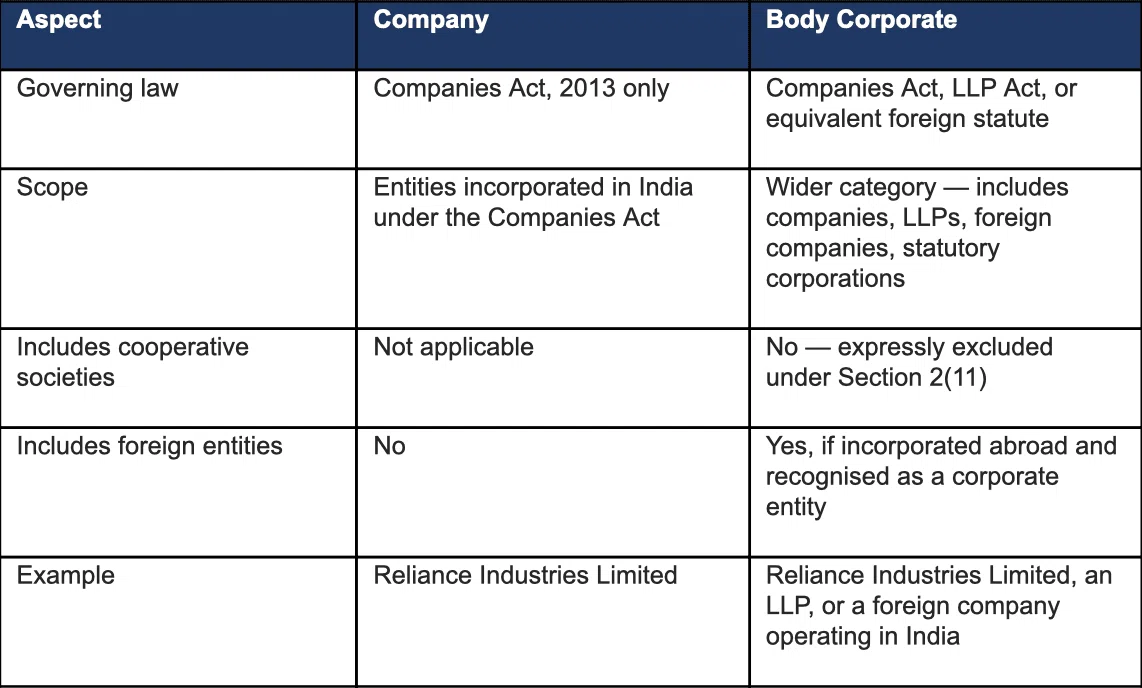
Why This Distinction Matters in Practice?
For founders, in-house counsel, and compliance teams, getting this distinction right is not academic. It affects how definitions clauses are drafted in shareholder agreements, how eligibility is assessed for related-party and investment provisions, and how foreign entities are treated under FEMA and Companies Act cross-references. A definitions clause that says "body corporate" instead of "company" is deliberately reaching further — to LLPs, foreign entities, and statutory corporations — and missing that distinction while drafting or reviewing an agreement can create unintended coverage or unintended gaps.
As a general rule of thumb: if a transaction or provision is meant to apply only to Indian-registered companies, use "company." If it is meant to capture a wider set of corporate structures, including LLPs or foreign entities, "body corporate" is the more accurate term to use.
This article is intended for general informational purposes and does not constitute legal advice. For advice specific to your transaction or entity structure, please consult a qualified professional.
The Lawgical Station team brings together CAs, CSs and tax specialists with decades of combined experience advising founders, SMEs and professionals on tax, compliance and business structuring across India.