Trademark Class Search Explained: A Founder's Guide
Filing a trademark under the wrong class can leave your brand unprotected. Learn how trademark class search works in India, how to choose the correct NICE Classification, avoid objections, and protect your business before filing
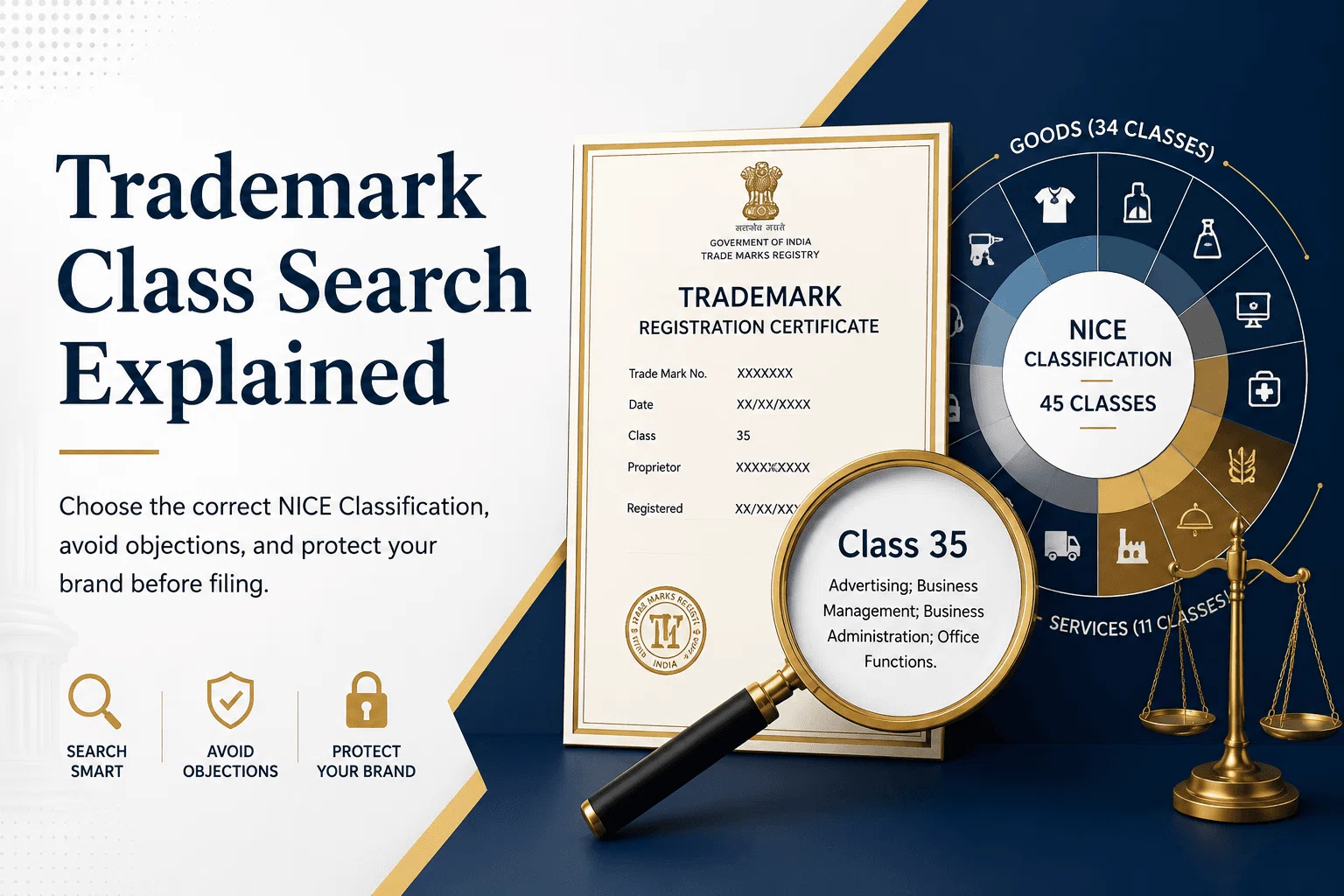
Most founders pick a trademark class by guessing. That single guess can get your application objected to, or worse, leave your brand unprotected in the very category where a competitor operates. Getting the class right before you file isn't optional — it decides what your trademark actually protects.
What is a Trademark Class
India follows the NICE Classification, an international system dividing goods and services into 45 classes — 34 for goods, 11 for services. Under the Trade Marks Act, 1999, and the Trade Marks Rules, 2017, every application must specify the class in which protection is sought.
A class isn't just a label. It defines the boundary of your legal monopoly. Registering “Zara” in Class 25 (clothing) gives you zero rights if someone uses it for Class 43 (restaurants).
Why Class Search Matters
Before filing, you must check the Trademark Public Search portal (ipindiaonline.gov.in) to see if an identical or deceptively similar mark already exists in your class. Skipping this step is the top reason applications get objected to under Section 11 of the Act (relative grounds for refusal).
How to Search the Right Class
- Identify your actual goods or services — not your industry broadly.
- Match them against the NICE Classification list published by the Trademark Registry.
- Run a public search using your brand name plus phonetic variants.
- Check adjacent classes too — many businesses need multi-class protection.
Common Mistakes
- Filing under one class when the business spans multiple (e.g., a food brand selling online needs Class 29/30 plus Class 35).
- Assuming a company name search is the same as a trademark search — it isn't.
- Ignoring phonetically similar marks already registered.
- Choosing a class based on competitors' filings without verifying it fits your own use.
- Skipping the search entirely and filing directly, risking rejection and wasted fees.
What Should You Do?
- Always search before filing, not after.
- Identify every class your business touches, present and near-future.
- Keep proof of your search (screenshots, date) for your records.
- Consult a trademark professional if your brand spans goods and services both.
- Re-check classification periodically — NICE editions get updated.
Frequently Asked Questions
Q1. How many trademark classes are there in India?
45 classes total — 34 for goods and 11 for services, as per the NICE Classification adopted under the Trade Marks Rules, 2017.
Q2. Can one trademark cover multiple classes?
Yes. You can file a multi-class application, though it involves separate government fees for each class selected.
Q3. Is trademark class search mandatory before filing?
It's not legally mandatory but strongly advisable — it reduces objection risk and helps you assess whether your mark is already taken.
Q4. Where can I do a free trademark class search in India?
On the official IP India Trademark Public Search portal at ipindiaonline.gov.in, free of cost.
Final Takeaway
Choosing the wrong trademark class can cost you money, time, and sometimes your brand identity itself. A proper class search before filing isn't a formality — it's what makes your trademark actually enforceable. If you're unsure which class fits your business, it's worth getting a professional to check before you file.
The Lawgical Station team brings together CAs, CSs and tax specialists with decades of combined experience advising founders, SMEs and professionals on tax, compliance and business structuring across India.