Can NRIs Become Directors in India? The Resident Director Rule Most People Get Backwards
Can an NRI be a director in an Indian company? Yes, but missing the 182-day physical presence rule for resident directors can cost you lakhs in penalties. Discover how to stay compliant.

Yes — an NRI can be appointed as a director of an Indian company, and can even hold 100% of its shares in most sectors. What trips people up isn't whether an NRI can be a director. It's a separate, easily confused requirement: every Indian company must also have at least one resident director under Section 149(3) of the Companies Act, 2013 — and “resident” here has nothing to do with your NRI status under FEMA or the Income Tax Act.
Confuse the two, and you can end up running a company that's technically non-compliant from day one, without realising it. Here is exactly who can be a director, what the resident director rule actually requires, and the one mix-up that gets founders penalised.
Can an NRI be a director in an Indian company?
Yes, without restriction. The Companies Act, 2013 allows NRIs and foreign nationals to be appointed as directors in Indian companies, and they can also own shares — including up to 100% equity in an Indian private limited company — subject to sectoral FDI limits. Nationality and residency status are simply not disqualifying factors for a director role in themselves.
Where the law does intervene is at the company level, not the individual level: Section 149(3) of the Companies Act, 2013 mandates that every Indian company must have at least one director who has stayed in India for not less than 182 days in the previous calendar year. This applies regardless of ownership structure — even a company that is 100% NRI-owned, incorporated entirely remotely, still needs this one resident appointment on its board.
The resident director requirement, explained properly
This is the requirement that catches almost every NRI founder off guard, precisely because it sounds like it's about citizenship when it's actually about physical presence.
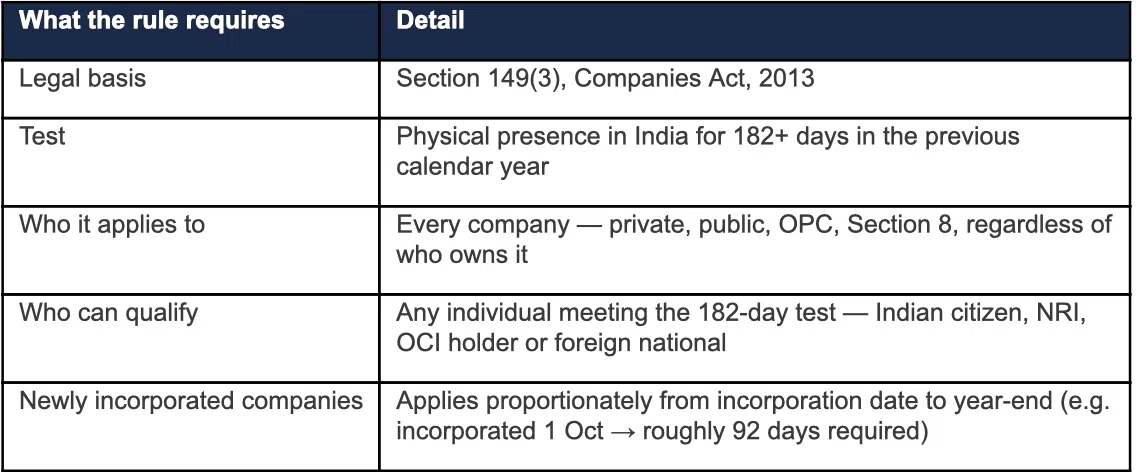
- An India-based co-founder, employee or family member who already meets the 182-day test.
- A professional nominee resident director — typically a practising Company Secretary who takes on this role for a fee, generally in the range of INR 15,000–INR 30,000 per year.
Either route works. What doesn't work is assuming the requirement disappears just because every shareholder and every other director is based abroad.
The trap: NRI status and “resident director” are not the same test
Here's the mix-up that causes real damage. An NRI's designation under FEMA and their income tax residency status do not determine whether they qualify as a resident director under the Companies Act — only physical presence in India for 182 days does.
That cuts both ways, and founders get it wrong in both directions:
-
Wrongly assuming an NRI is automatically disqualified. An NRI who spends more than half the year in India can serve as the company's resident director while retaining NRI status for banking and tax purposes — the 182-day company-law test runs completely independently of the tax residency count.
-
Wrongly assuming appointing “an NRI director” satisfies the requirement. It doesn't. Unless that specific person actually crossed 182 days of physical presence in India in the relevant calendar year, the company still has no valid resident director — even with an NRI's name on the board.
The rule tracks days, not documents
The 182-day test counts physical presence in India, not passports, visas, or tax status. Get this backwards and a company can drift into default for years before anyone notices — which is exactly what has happened in several recent enforcement cases.
DIN, DSC and documentation for NRI directors
Every director — resident or not — needs a Director Identification Number (DIN) before appointment. For NRIs and foreign nationals, the paperwork carries a few extra steps:
- Digital Signature Certificate (DSC) — issued by an Indian certifying authority; foreign documents supporting the application must be notarized and either apostilled or consularized.
- DIN application — filed via SPICe+ Part B at incorporation, or Form DIR-3 for a later appointment, using a passport in place of a PAN card for identity proof.
- PAN card — a foreign national acting as a resident director must additionally obtain an Indian PAN card, which itself requires a valid Indian address and visa.
- Apostille / consularization — required for all foreign-issued identity and address proofs under the Hague Convention framework, applicable across 125+ member countries.
None of this is a barrier to appointment — it's simply a longer document trail than an Indian-resident director's filing.
Can an NRI be a Managing Director or Whole-Time Director?
It depends on whether the company is private or public.
- Private limited companies: Section 197, which governs managerial remuneration, applies only to public limited companies — so an NRI can be appointed Managing Director, Whole-Time Director or Manager of an Indian private limited company without those restrictions.
- Public limited companies: Full compliance with Sections 196 and 197 and Schedule V is required, and one of the conditions under Part I of Schedule V for appointing an MD, WTD or Manager without Central Government approval is that the appointee is a resident of India.
So an NRI can head a private company as MD/WTD freely. In a public company, that same appointment either needs the individual to meet the residency condition, or requires Central Government approval.
Shareholding, FDI and the FEMA angle
Directorship and shareholding are governed separately, and NRIs are largely unrestricted on both counts:
-
NRIs, OCIs and foreign nationals can hold up to 100% FDI in most sectors under the automatic route, with no prior RBI approval needed.
-
Reporting is still mandatory: share allotments to non-residents must be filed via Form FC-GPR on the FIRMS portal within the prescribed window after allotment.
-
Sector-specific caps and conditions (defence, telecom, media, insurance, etc.) still apply and should be checked before structuring the cap table.
This is a FEMA compliance step, not a director-eligibility issue — but it's the piece most NRI founders bundle into the same conversation, so it's worth flagging alongside the resident director question.
Penalties for non-compliance
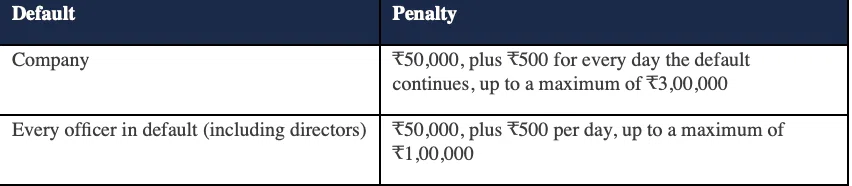
Beyond the fine, non-compliance can trigger wider regulatory scrutiny of the company's governance, delaying other ROC and FEMA filings and approvals. For a lean, NRI-founded startup, that can mean a frozen fundraise at exactly the wrong moment.
What to do now
- Separate the two questions. “Can an NRI be a director?” and “Does my company have a resident director?” are answered by different rules — don't let one reassure you about the other.
- Count days, not passports. If an NRI director genuinely spent 182+ days in India last calendar year, they may already satisfy the resident director test themselves.
- If not, appoint someone who does — a co-founder, employee, family member, or a professional nominee resident director.
- Budget for the extra documentation — DSC, apostille, and Indian PAN — if the appointee is a foreign national or NRI without an existing Indian PAN.
- File FC-GPR on time if shares are being allotted to NRI or foreign shareholders, separately from any director-related filing.
Frequently asked questions
1. Can an NRI be a 100% shareholder and sole director of an Indian company?
An NRI can hold up to 100% shareholding in most sectors. However, the company still needs a separate resident director meeting the 182-day test — so an NRI cannot usually be the sole director unless they personally meet that residency threshold.
2. Does being an NRI disqualify someone from being a resident director?
No. NRI status under FEMA and tax residency status are irrelevant to this test. Only physical presence in India for 182+ days in the previous calendar year matters.
3. Can an NRI be a Managing Director of a private limited company?
Yes. Section 197's remuneration restrictions apply only to public companies, so private companies can appoint an NRI as MD or Whole-Time Director without those conditions.
4. What documents does an NRI need to become a director in India?
A DIN application (via SPICe+ or DIR-3), a DSC from an Indian certifying authority, and notarized/apostilled copies of passport and address proof. A PAN card is additionally required if the NRI is also serving as the resident director.
5. What happens if a company has no resident director?
The company and its officers in default face penalties under Section 172 — up to INR 3,00,000 for the company and INR 1,00,000 per officer — and other MCA and FEMA filings can face delays or scrutiny.
Get your board structure right from day one
Not sure whether your board currently satisfies the resident director requirement, or how to structure a director appointment for an NRI founder? We help NRI-owned and foreign-invested companies get their board composition, DIN/DSC filings and FEMA reporting right from day one.
Book a free compliance consultation now.
The Lawgical Station team brings together CAs, CSs and tax specialists with decades of combined experience advising founders, SMEs and professionals on tax, compliance and business structuring across India.