Do You Need to File an ITR Even If Your Income Is Below the Taxable Limit?
Even if your income falls below the basic exemption limit, the Income-tax Act may still require you to file an ITR. Here's when filing is mandatory, when it's optional, and why filing anyway often pays off.
Most taxpayers assume that if their income falls below the basic exemption limit, they have no reason to file an income tax return. That assumption can be costly. Under the Income-tax Act, 1961, the obligation to file and the obligation to pay tax are governed by separate provisions. FY 2025-26 (AY 2026-27) makes this distinction sharper than ever, especially with the enhanced Section 87A rebate under the new regime.
The Basic Rule
Under Section 139(1), filing is compulsory once gross total income exceeds the basic exemption limit — INR 4 lakh under the default new regime and INR 2.5 lakh under the old regime for FY 2025-26. A common misconception is that the higher Section 87A rebate, which makes income up to INR 12 lakh effectively tax-free under the new regime, removes the filing requirement. It does not. Someone earning INR 10 lakh pays zero tax after rebate but must still file, since their income exceeds INR 4 lakh.
When Filing Is Mandatory Despite Low Income
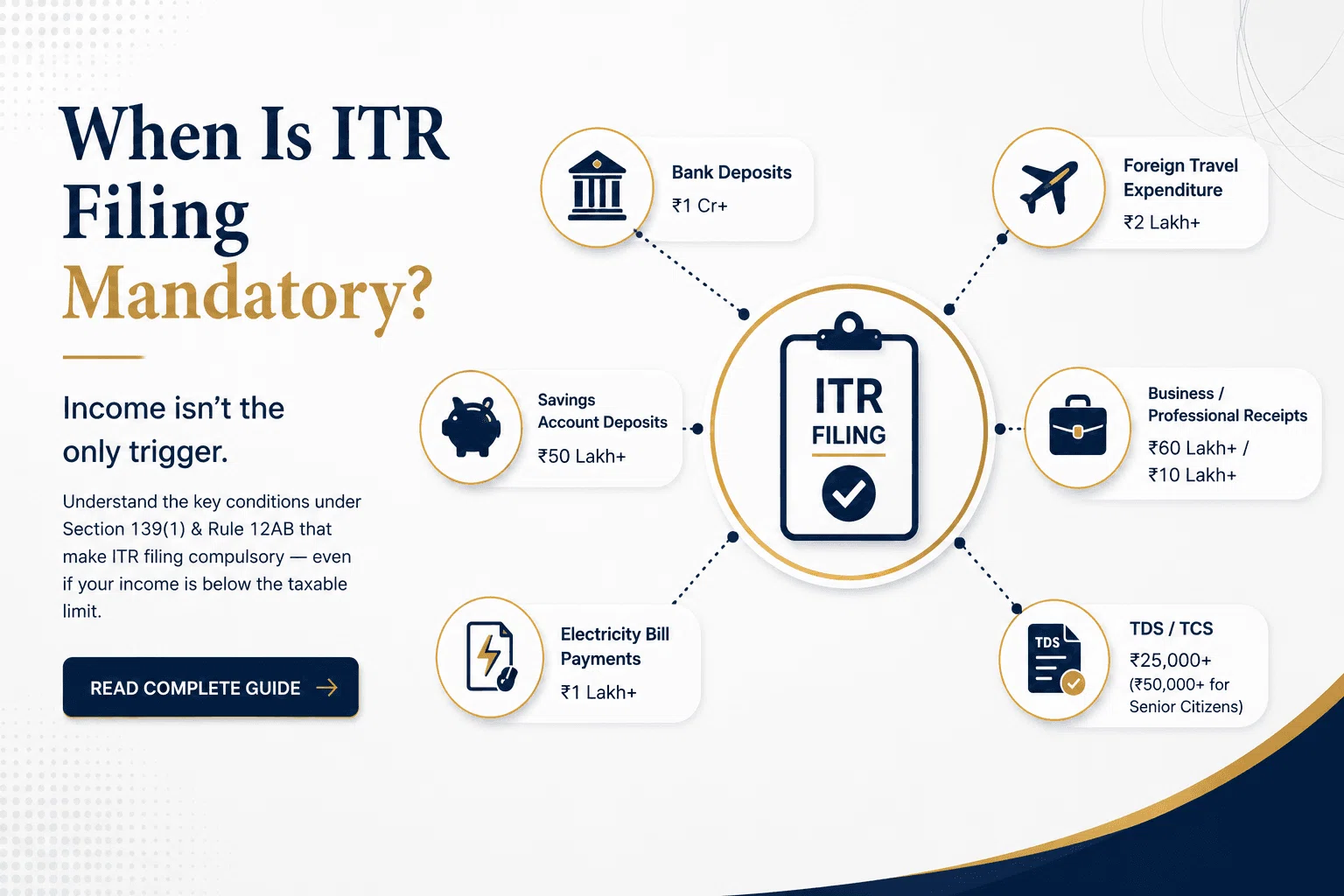
The seventh proviso to Section 139(1), read with Rule 12AB of the Income-tax Rules, 1962, requires a return even when total income is below the exemption limit, if any of the following apply during the year:
- Deposits of INR 1 crore or more in one or more current accounts
- Deposits of INR 50 lakh or more in one or more savings accounts
- Electricity bill payments exceeding INR 1 lakh in aggregate
- Expenditure exceeding INR 2 lakh on foreign travel (self or another person)
- Gross business receipts exceeding INR 60 lakh, or professional receipts exceeding INR 10 lakh
- Aggregate TDS/TCS of INR 25,000 or more (INR 50,000 for senior citizens) Filing is also mandatory, regardless of income, for residents holding foreign assets or signing authority in foreign accounts, those with foreign income, and companies or firms, which must file every year irrespective of profit or loss.
When Filing Is Voluntary — and Worth It
Even outside these triggers, filing voluntarily helps you claim a refund of excess TDS/TCS, carry forward business or capital losses (allowed only if filed by the due date), and produce a verified income record for loan, visa, or tender purposes.
Practical Example
An individual has taxable income of INR 3.2 lakh for FY 2025-26 but deposits INR 55 lakh across savings accounts during the year. Despite income being below INR 4 lakh, the Rule 12AB savings-deposit threshold is triggered, making ITR filing compulsory — the deposit itself need not be taxable income for the obligation to arise.
Frequently Asked Questions
Q1. Does a zero-tax outcome under the new regime rebate mean I don't need to file?
No. Rebate reduces tax payable; it does not exempt you from filing once gross income exceeds the basic exemption limit.
Q2. Can I claim a TDS refund without filing?
No. A return is the only mechanism to claim a refund of tax deducted or collected at source.
Q3. Which law applies for AY 2026-27 filings?
The return for FY 2025-26 (AY 2026-27) continues to be governed by the Income-tax Act, 1961, and the seventh proviso to Section 139(1) read with Rule 12AB, even though the Income-tax Act, 2025 takes effect from tax year 2026-27 onward.
Q4. I only have savings account deposits, no business income — am I still covered by Rule 12AB?
Yes. The INR 50 lakh savings-deposit threshold applies to individuals regardless of whether they have business income. Deposits are aggregated across all savings accounts held during the year, and the obligation arises even if the funds are not taxable.
Q5. Is filing mandatory if I want to carry forward a capital loss, even though my income is below the exemption limit?
Yes. Carry-forward of business or capital losses to future years is permitted only if the return is filed by the original due date under Section 139(1), irrespective of whether total income exceeds the exemption limit.
Q6. What happens if I meet a Rule 12AB condition but don't file?
Non-filing despite a mandatory trigger can attract late-filing fees under Section 234F, interest under Section 234A, and scrutiny, since the condition is reported separately from income and is reconciled against data the Department already holds through AIS/TIS.
The Lawgical Station team brings together CAs, CSs and tax specialists with decades of combined experience advising founders, SMEs and professionals on tax, compliance and business structuring across India.