KYC Is Now Once Every Three Years: New Rules, Deadlines and the One Trap to Avoid
New KYC Rules
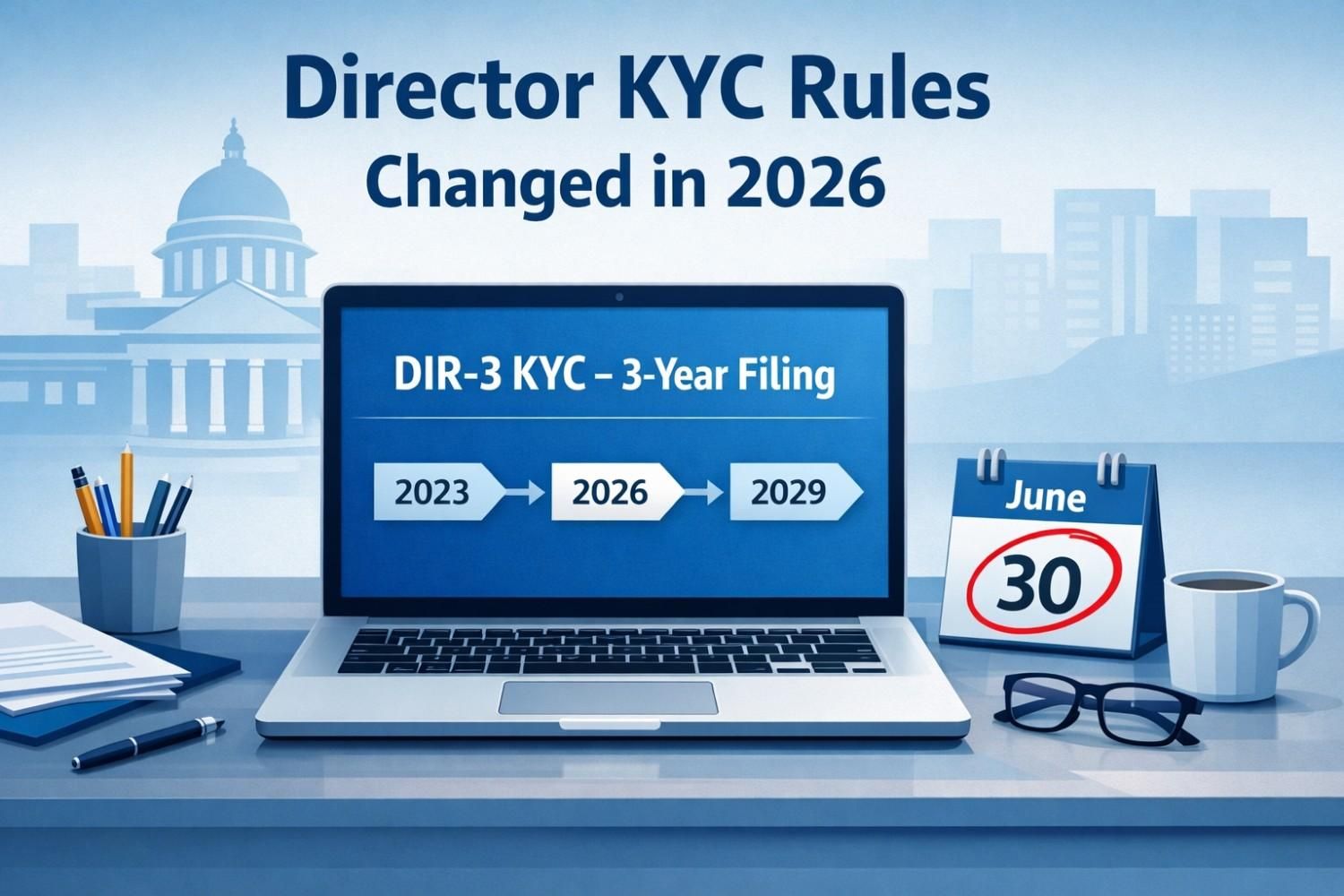
From 31 March 2026, DIR-3 KYC is no longer an annual filing. Under the Companies (Appointment and Qualification of Directors) Amendment Rules, 2025 (notified as G.S.R. 943(E) on 31 December 2025), every DIN holder now files KYC once every three consecutive financial years, by 30 June of the year following the third year. The old annual deadline of 30 September is gone, and the e-form and web service have been merged into a single Form DIR-3 KYC Web.
It is a genuine ease-of-compliance win for directors. But the new cycle has a counter-intuitive trap built into it, and getting your next due date wrong still leads to a deactivated DIN. Here is exactly what changed, when you file, and what to watch for.
What changed on 31 March 2026
The Ministry of Corporate Affairs reviewed the annual KYC requirement under Rule 12A of the Companies (Appointment and Qualification of Directors) Rules, 2014, acting on the recommendation of the High Level Committee on Non-Financial Regulatory Reforms and stakeholder feedback. The result is a simpler intimation made once every three years rather than every year. In summary: • Frequency: once every three consecutive financial years, instead of annually. • Deadline: 30 June of the year immediately following the third year (not 30 September). • One form: the earlier DIR-3 KYC e-form and the separate web service are merged into a single Form DIR-3 KYC Web. • Five uses: the revised form covers KYC compliance, plus updating your mobile number, email address or residential address, and re-activating a DIN. • Still immediate for changes: any change of mobile, email or address must still be filed within 30 days, whichever year of the cycle you are in.
When is your next DIR-3 KYC due?
This is the part people get wrong. Your next due date is counted from the financial year your DIN was allotted, not from the date of your last KYC filing. Find your situation in the table below.
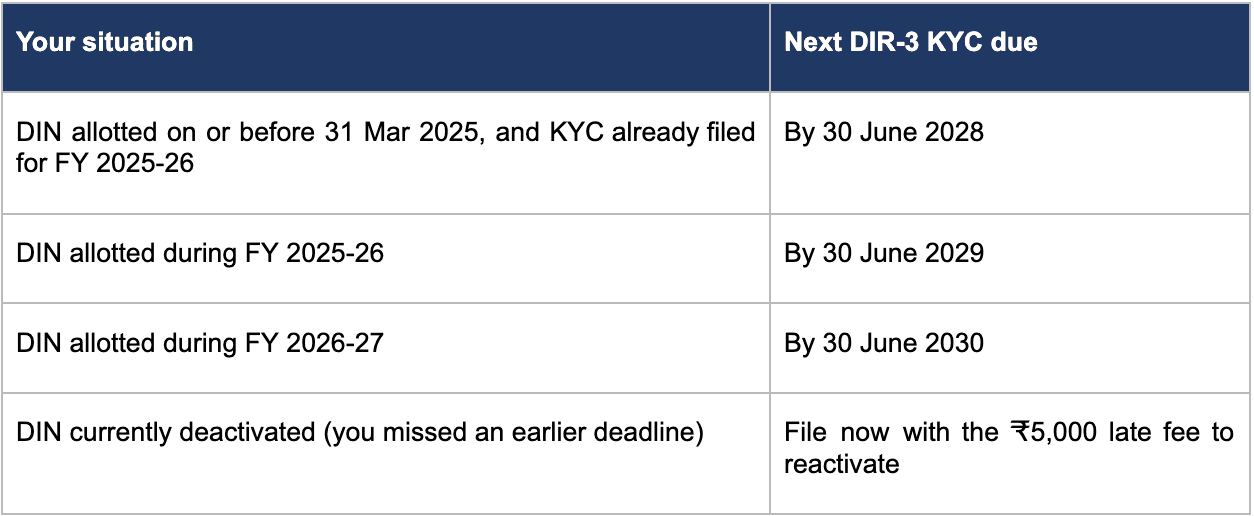
The cycle in one line: file once every three consecutive financial years, by 30 June of the year immediately following the third year. If none of your details change, you file nothing at all in the two years in between.
The trap: a mid-cycle update does not reset the clock
Here is the catch that will catch people. Changing your mobile number, email or residential address mid-cycle is a separate obligation that must be filed within 30 days. But doing so does not buy you a fresh three years. Your three-year due date stays anchored to the financial year your DIN was allotted, regardless of how many mid-cycle updates you file in between. Many directors will assume an amendment resets the cycle. It does not, and assuming otherwise is how an active director quietly drifts past a due date.
Who has to file
Anyone holding a DIN as on 31 March of a financial year must complete KYC for that cycle, even if they are not currently on any board. That sweeps in more people than most expect: • Directors of any company — public, private, OPC or Section 8. • Directors who have resigned but still hold a valid DIN. • Designated Partners of LLPs who hold a DIN. • Foreign nationals holding a DIN. • Anyone who was ever allotted a DIN, even if it is dormant or has never been used.
Do you need a CA, CS or CMA?
It depends entirely on what you are filing for:
• Routine KYC with no change in details — no. There is no DSC and no professional certification; verification is simply by OTP sent to your registered mobile and email. • Updating your details or reactivating a DIN — yes. The form then needs the DIN holder’s digital signature and certification by a practising Chartered Accountant, Company Secretary or Cost Accountant.
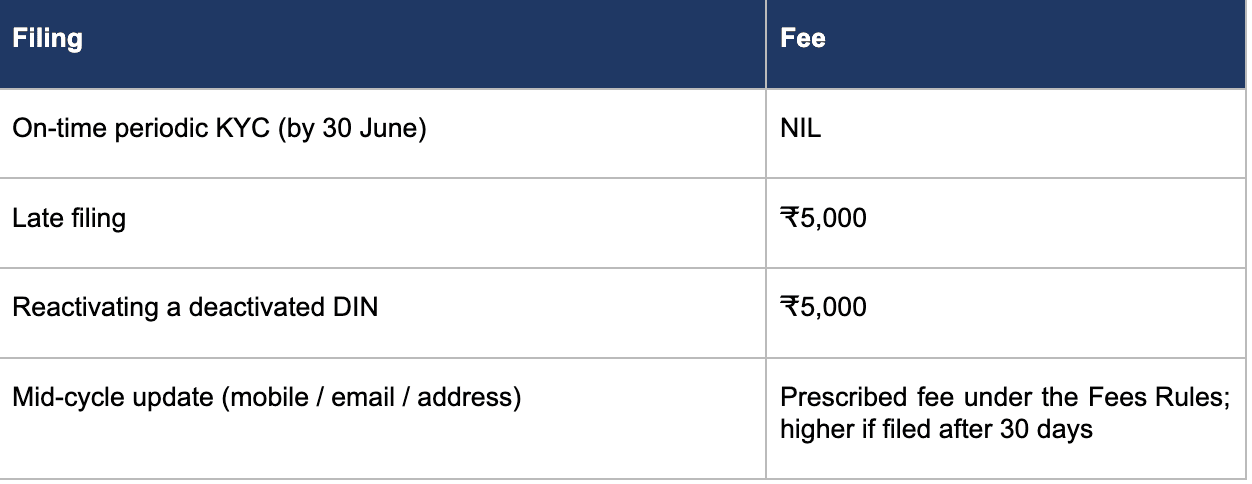
Fees at a glance
What happens if you miss it
Miss your deadline and the DIN is marked “Deactivated due to non-filing of DIR-3 KYC.” While it is deactivated you cannot act as a director, cannot be appointed to a new board, and every MCA filing that relies on that DIN — annual returns, financial statements, board resolutions — is blocked. On a two-director company, a single deactivated DIN can freeze the entire filing pipeline. Reactivation means filing the form with the ₹5,000 fee. And because the form carries a declaration, false statements in it can attract liability under Sections 448 and 449 of the Companies Act, 2013.
What to do now
Note the financial year your DIN was allotted — that single fact anchors your entire cycle.
Work out your next due date from the table above and diarise 30 June of that year.
Treat any change of mobile, email or address as a separate filing due within 30 days — not something that resets your cycle.
Keep a simple DIN tracker (DIN, last KYC year, next due date), because the MCA portal does not show a next-due utility.
Re-file any draft saved before 31 March 2026. Any DIR-3 KYC saved as a draft before that date was auto-cancelled; submit a fresh Form DIR-3 KYC Web.
Frequently asked questions ( FAQs )
##### Is DIR-3 KYC still required every year? No. From 31 March 2026, DIR-3 KYC is filed once every three consecutive financial years, by 30 June of the year following the third year. You only file in the intervening years if your mobile, email or address changes. ##### What is the new DIR-3 KYC deadline? The deadline is 30 June of the year immediately following your three-year cycle, replacing the earlier 30 September annual deadline. For example, most existing directors who filed for FY 2025-26 are next due by 30 June 2028. ##### Does updating my email or mobile reset the three-year cycle? No. A change of mobile, email or address must be filed within 30 days, but it does not reset your cycle. Your next periodic KYC stays anchored to the financial year your DIN was allotted. ##### Do I need a CA or CS for routine DIR-3 KYC? Not for a routine filing with no change in details — that is verified by OTP, with no DSC or professional certification. You do need a DSC and certification by a practising CA, CS or CMA if you are updating details or reactivating a DIN. ##### What is the penalty for missing DIR-3 KYC? The DIN is deactivated, you cannot act as a director, and MCA filings using that DIN are blocked. Reactivation requires filing the form with a ₹5,000 fee. False statements in the form can attract liability under Sections 448 and 449.
Key takeaways
• DIR-3 KYC is now once every three years, by 30 June — effective 31 March 2026 under G.S.R. 943(E). • Your due date is counted from the year your DIN was allotted, not from your last filing. • A mid-cycle update does not reset the clock — but it is still due within 30 days of the change. • On-time KYC is free and OTP-verified; updates and reactivations need a DSC and a practising professional, and late filing costs ₹5,000. • A deactivated DIN can freeze a company’s entire filing pipeline, so track your due date — the MCA portal will not remind you.
Not sure when your DIN’s next KYC is due?
The MCA portal does not show a next-due date, and one missed deadline can block every filing your company makes. We track DIR-3 KYC cycles for directors and designated partners so nothing slips — and handle updates and reactivations end to end.
The Lawgical Station team brings together CAs, CSs and tax specialists with decades of combined experience advising founders, SMEs and professionals on tax, compliance and business structuring across India.